
Investing in the Whole Home: Night's Story Through the School Family Initiative
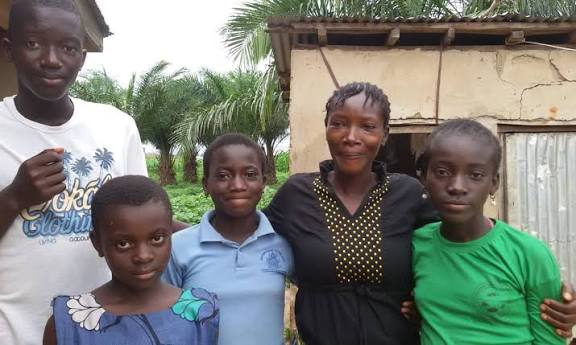
Nakirya Night is thirteen years old and lives with her mother and three younger siblings in a small trading village outside Kamuli town, in Eastern Uganda. Her mother, Christine, supports the household by selling tomatoes and dried fish at the local market — a business that brings in barely enough on a good week, and nothing at all when the rains ruin the produce or a child falls sick.
By the middle of last year, the math had stopped working. School fees, uniform replacement, and exercise books for four children had become impossible to cover alongside food and rent. Christine made the decision many mothers in her position are forced into: Night, the eldest, would stay home.
"It was not that I didn't want her to study," Christine says. "It was that I had to choose who eats and who stays in class, and I could not choose both."
This is the exact pattern Learn Plus Foundation's School Family Initiative (SFI) was designed around. Rather than treating a girl's school dropout as an isolated problem to fix with a one-time fees payment, SFI starts from a harder truth: in low-income households, a girl's education is only as stable as her family's income. Pay her fees once, and the same pressure returns next term. So SFI works with the whole household — not just the child.
When SFI staff met Christine, the conversation wasn't only about Night. It was about the tomato business itself: how much stock she could realistically move, what was eating her margins, and whether a small, structured push — training in basic record-keeping, a savings group with other market women, and a modest capital top-up — could make the business stable enough to carry school costs without the same cliff-edge choice each term.
Christine joined an SFI-supported village savings group and received training in simple bookkeeping and stock planning. Within two months, she'd expanded from tomatoes and dried fish to include onions and cooking oil in small quantities — steadier sellers that didn't spoil if the market was slow. The savings group also meant that when a bad week hit, she had a buffer that wasn't Night's school fees.
"Now I know how much I make and how much I spend," Christine says. "Before, I was just selling and hoping. Now I plan."
Night returned to school at the start of the following term. She's now back with her age group, catching up on the two terms she missed, and says she wants to study business — "so I can help my mother make the shop bigger," she says.
Her mother is more direct about what changed. "Nobody gave me money for her school fees," Christine says. "They helped me build something that pays the fees itself. That is different. That stays."
Night's story is the model SFI is built on: a girl stays in school not because a single bill was paid, but because her family's ability to keep paying it was strengthened at the root. It's slower than a one-off donation, and harder to capture in a single number — but it's designed to hold up in the terms that follow, not just the one right in front of it.
By the middle of last year, the math had stopped working. School fees, uniform replacement, and exercise books for four children had become impossible to cover alongside food and rent. Christine made the decision many mothers in her position are forced into: Night, the eldest, would stay home.
"It was not that I didn't want her to study," Christine says. "It was that I had to choose who eats and who stays in class, and I could not choose both."
This is the exact pattern Learn Plus Foundation's School Family Initiative (SFI) was designed around. Rather than treating a girl's school dropout as an isolated problem to fix with a one-time fees payment, SFI starts from a harder truth: in low-income households, a girl's education is only as stable as her family's income. Pay her fees once, and the same pressure returns next term. So SFI works with the whole household — not just the child.
When SFI staff met Christine, the conversation wasn't only about Night. It was about the tomato business itself: how much stock she could realistically move, what was eating her margins, and whether a small, structured push — training in basic record-keeping, a savings group with other market women, and a modest capital top-up — could make the business stable enough to carry school costs without the same cliff-edge choice each term.
Christine joined an SFI-supported village savings group and received training in simple bookkeeping and stock planning. Within two months, she'd expanded from tomatoes and dried fish to include onions and cooking oil in small quantities — steadier sellers that didn't spoil if the market was slow. The savings group also meant that when a bad week hit, she had a buffer that wasn't Night's school fees.
"Now I know how much I make and how much I spend," Christine says. "Before, I was just selling and hoping. Now I plan."
Night returned to school at the start of the following term. She's now back with her age group, catching up on the two terms she missed, and says she wants to study business — "so I can help my mother make the shop bigger," she says.
Her mother is more direct about what changed. "Nobody gave me money for her school fees," Christine says. "They helped me build something that pays the fees itself. That is different. That stays."
Night's story is the model SFI is built on: a girl stays in school not because a single bill was paid, but because her family's ability to keep paying it was strengthened at the root. It's slower than a one-off donation, and harder to capture in a single number — but it's designed to hold up in the terms that follow, not just the one right in front of it.